Introduction
EMI makes big purchases feel affordable by spreading the cost over several months. But without careful planning, the convenience of monthly payments can hide real costs and lead to financial stress.
This guide highlights the most common mistakes people make when buying on EMI, so you can avoid them in your own purchase decisions.
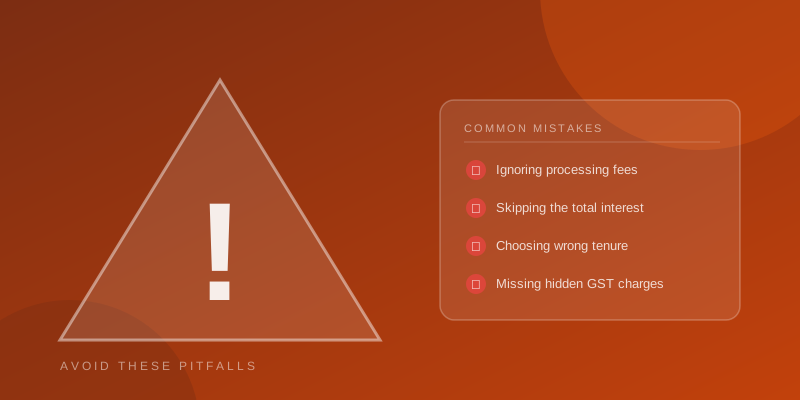
Mistake 1: Ignoring The Processing Fee
Many buyers focus on the interest rate or the “no cost” tagline and overlook the processing fee. On a No Cost EMI, the processing fee is often the only true cost. If the fee plus GST exceeds the cash discount available on upfront payment, EMI is more expensive.
How to avoid: Always add the processing fee and 18% GST to your effective cost calculation. Compare with upfront payment.
Mistake 2: Ignoring GST
Buyers often forget that GST is added to processing fees, foreclosure charges, and late fees. A ₹500 processing fee actually costs ₹590 once GST is added.
How to avoid: Multiply any fee by 1.18 to get the true cost including GST.
Mistake 3: Ignoring Cashback Conditions
Cashback offers often come with conditions such as minimum spend, specific payment methods, or a cap on the maximum benefit. A 10% cashback may sound attractive but cap at ₹500, giving you only 1% effective discount on a large purchase.
How to avoid: Read the full offer terms. Compute the effective discount percentage before assuming the savings.
Mistake 4: Overextending The Budget
Just because a product can be paid in 24 instalments does not mean you should. A long tenure reduces the monthly EMI but increases the total interest paid.
How to avoid: Choose the shortest tenure you can afford. Use an EMI calculator to compare total interest across tenures before selecting.
Mistake 5: Forgetting About The Interest-Free Period Loss
When you convert a credit card purchase to EMI, you lose the interest-free period on that purchase. If you would have paid the bill in full next month, EMI actually costs you the interest you would not have paid otherwise.
How to avoid: Only use EMI when you cannot pay the bill in full. If you have the cash, paying upfront is usually cheaper.
Mistake 6: Missing The First EMI Payment
The first EMI is usually debited within 30 to 45 days of purchase. If you forget about it, you may be charged a late fee plus GST, and your credit score may be affected.
How to avoid: Set a calendar reminder for the EMI debit date. Ensure sufficient balance in the account linked to your credit card or loan.
Mistake 7: Not Comparing Across Banks
Different banks charge different processing fees and interest rates. Choosing the first EMI option offered by the merchant may not be the cheapest.
How to avoid: Check the EMI options from 2-3 different banks for the same purchase. Compare total cost, not just monthly EMI.
Mistake 8: Treating No Cost EMI As Free Money
No Cost EMI has a cost — it is borne by the merchant through a discount. The discount given to enable No Cost EMI may be more than the cash discount you would have received on upfront payment.
How to avoid: Compare No Cost EMI (effective cost = product price + processing fee + GST) with upfront payment (effective cost = product price - cash discount). Choose whichever is lower.
Mistake 9: Prepaying Without Checking Foreclosure Charges
Prepaying an EMI is a good way to save interest. But many banks charge a foreclosure fee of 2% to 4% of the outstanding principal, which can offset the interest savings.
How to avoid: Check the foreclosure terms before setting up the EMI. Calculate whether prepayment still saves money after the fee.
Mistake 10: Buying On EMI To Show Affluence
Some buyers use EMI to project a lifestyle they cannot afford. A ₹1,50,000 phone on 24-month EMI may look manageable at ₹7,000 per month, but the total cost is significantly higher, and the monthly payment reduces the budget for essentials.
How to avoid: Use the 50/30/20 rule: 50% of income for needs, 30% for wants, 20% for savings. Total EMIs should not exceed 10% to 15% of monthly income.
Mistake 11: Not Reading The EMI Schedule
The EMI schedule shows how much of each instalment goes to principal versus interest. In the early months, most of the EMI is interest. Understanding this helps you decide whether prepayment is worthwhile.
How to avoid: Ask the bank for the amortisation schedule. Review it before signing up.
Mistake 12: Ignoring Impact On Credit Score
Multiple active EMIs can signal financial stress to lenders. A high EMI-to-income ratio reduces your eligibility for future loans.
How to avoid: Limit the number of active EMIs. Close older EMIs before starting new ones.
Example: How Mistakes Compound
Consider a buyer who makes three common mistakes on a ₹80,000 laptop purchase:
- Chooses 24-month No Cost EMI without comparing tenures — total cost ₹81,000 (with fees and GST)
- Ignores a 7% cash discount on upfront payment — missed saving ₹5,600
- Misses the first EMI and pays a ₹500 late fee + GST — extra cost ₹590
Total avoidable cost: ₹7,190
A simple five-minute calculation using the Effective Cost Calculator would have revealed this.
Related Calculators
Related Guides
Disclaimer
This guide is for educational purposes only and does not constitute financial advice. EMI terms, processing fees, and foreclosure charges vary by bank and merchant. Always read the offer terms carefully and consider your personal financial situation before committing to an EMI purchase.